Staying Intra-Muros in Saint-Malo: an honest guide
Updated on 23 October 2026
_%D0%A1%D0%B5%D0%BD-%D0%9C%D0%B0%D0%BB%D0%BE._Rue_Sainte_Barbe_-_panoramio.jpg)
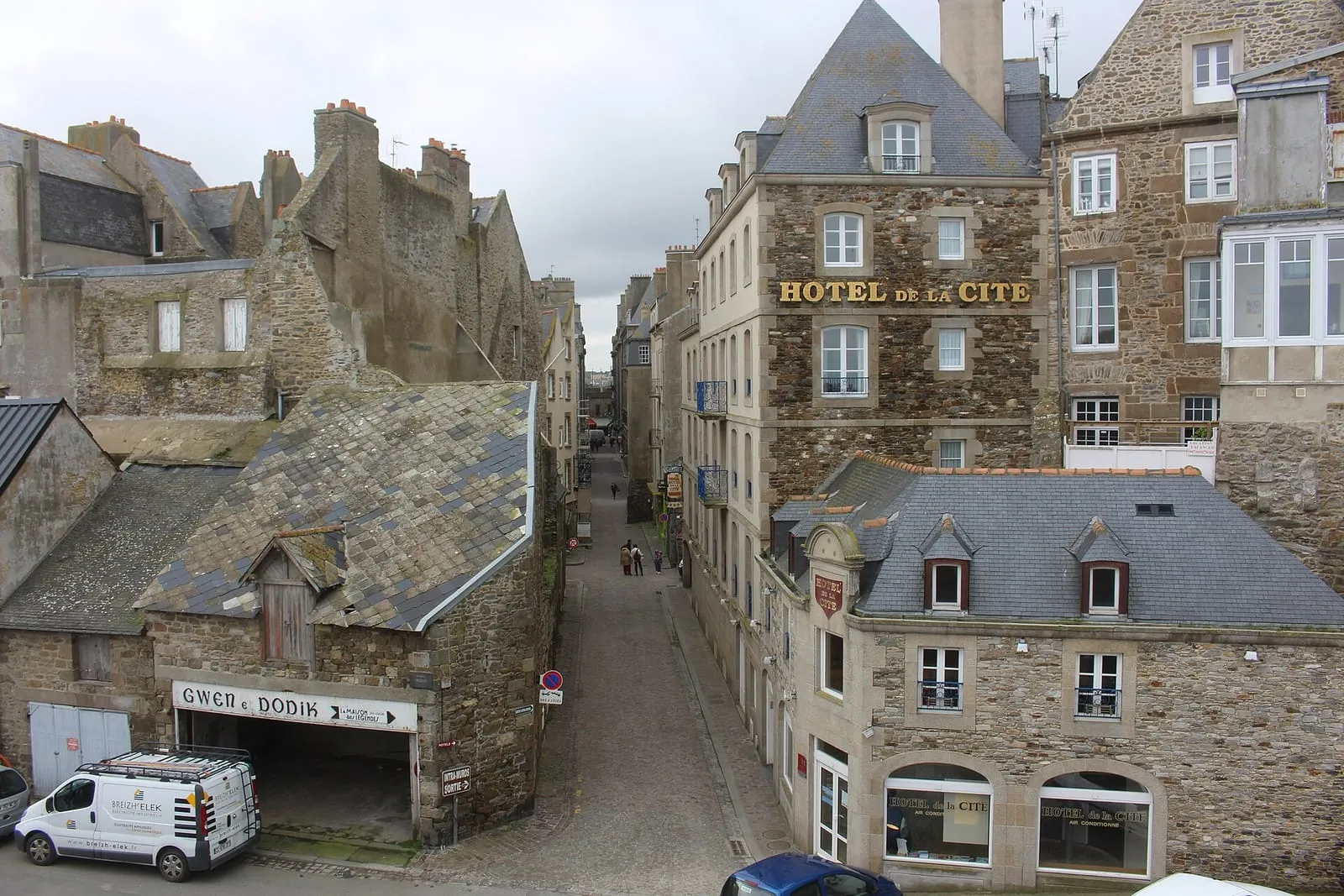
Intra-Muros packs in everything people come to Saint-Malo for: the granite, the ramparts, the shipowners’ houses, lanes smelling of crêpes and sea air. Sleeping there has real charm: early morning and evening, once the day-trippers have gone, the old town belongs to the people staying overnight. A few realities are worth knowing before you book, though; here they are, straight.
The genuine advantages
Everything on foot. Restaurants, ramparts, the Bon-Secours and Éventail beaches, the station fifteen minutes away: it is the best car-free base in town.
The tide two minutes away. Almost no room sees the sea, but the rampart walk is Saint-Malo’s finest spring tide viewpoint: the Fort National cut off by the flood, the Bon-Secours seawater pool emerging on the ebb, Grand Bé uncovering at big coefficients. The full circuit takes a short hour, and it changes with every tide.
The privilege of the quiet hours
Sleeping inside the walls means living the town at the hours when it belongs to itself. In the morning, before the day-trippers arrive: a deserted wall walk, bakeries opening, high water or bare sands depending on the day. The circuit of the ramparts at sunrise, alone, is worth every guidebook. In the evening, after the coaches leave: the lanes recover their scale, the terraces breathe, and night inside the granite has a silence of its own, especially off season, when wind in the ramparts replaces the murmur of the streets.
Far more than the rare sea view, it is this access to the quiet hours that justifies sleeping inside rather than next door. On spring tide days it becomes a tactical advantage: you are up on the ramparts before anyone else for the morning high water.
Which street, which mood
Simplifying: around the cathedral and the Grand-Rue, you are at the centre of everything, and of everyone. Towards the Saint-Louis gate and the southern lanes, the streets sleep early: the right pick for light sleepers. Near the Saint-Vincent gate and the castle, you gain immediate access to the Sillon and the bustle, at the price of the bustle itself. The three addresses in the table below cover these registers; in every case, the question “street side or courtyard side?” is worth asking before the price.
What can spoil the stay, if you don’t know about it
Noise. From April to September the restaurant streets run late. Ask for a courtyard room, or pick an address in the quiet lanes towards the Saint-Louis gate.
The car. Restricted traffic, scarce and expensive parking: leave it at the gate car parks (Saint-Vincent, Paul Féval) and finish on foot. Ten minutes of cobbles with wheeled luggage: better to know that before you set off.
Stairs. Tall, narrow houses, few lifts. If that matters, ask before booking.
In practice
If your whole trip is built around a spring tide with swell, the Sillon seafront remains the better observation post. Many visitors do both: one night facing the sea for the tide, one night inside the walls for the town. Over two nights, that is probably the best formula.
Written and kept up to date by a Saint-Malo local in love with this coast. The story behind this guide
.jpg)

The next spring tides
- 27–29 October 2026100autumn
- 25–27 November 202697autumn
- 25–27 December 202699winter
See the full spring tide calendarAdd these dates to my calendar (.ics)
Compare places to stay
| Accommodation | Area | Tide advantage | Price | Book |
|---|---|---|---|---|
| La Maison des Armateurshotel | Intra-Muros · €€€420 m from the sea wall | Tide advantage : In the very heart of the walled town: no sea view from the rooms, but the rampart walk, the town's best spring tide balcony, is two minutes away. | €€€ | BookHotel website ↗ |
| Hôtel France & Chateaubriandhotel | Intra-Muros · €€310 m from the sea wall | Tide advantage : Against the Porte Saint-Vincent: some upper rooms glimpse the Fort National, which the tide turns from island to peninsula before your eyes. | €€ | BookHotel website ↗ |
| Hôtel Elizabethhotel | Intra-Muros · €€350 m from the sea wall | Tide advantage : A 16th-century house near the Saint-Louis gate: quiet within the walls, a five-minute walk from the Noires pier and the wave show. | €€ | BookHotel website ↗ |
Frequently asked questions
Can you see the sea from an Intra-Muros room?
Rarely, truly: the old town is shielded by its ramparts, which block the view at street level. A few upper rooms glimpse the Fort National or a slice of bay, but if a sea view is your priority, the Sillon seafront is the right call. Intra-Muros is chosen for its atmosphere.
Is Intra-Muros noisy at night?
The streets around the cathedral and the main gates stay lively late, especially in summer and at weekends. Addresses in the quiet lanes (towards the Saint-Louis gate, for instance) sleep much better. In February or November, the night-time silence of the walls is a rare luxury instead.
Can you drive into Intra-Muros?
Possible but not advisable: narrow streets, restricted traffic, scarce and expensive parking. The gate car parks (Saint-Vincent, Paul Féval) plus a ten-minute walk are the stress-free option; most hotels have no private parking.
Is Intra-Muros at risk during a spring tide?
The walled city was built precisely for this: perched behind its ramparts, it has looked down on the spring tides for centuries. The wave-flooding alerts concern first the Sillon seafront and the slipways; inside the walls, the only risk is a soaking of spray on the wall walk. Simply follow the préfecture's instructions on storm days.