Saint-Malo with kids: planning your day around the tide
Updated on 31 July 2026
,_swimming_pool_on_beach.JPG)
Bringing children to Saint-Malo means handing them a playground that changes shape twice a day. In the morning the sea beats against the sea wall; by mid-afternoon it has pulled back several hundred metres, leaving behind a desert of firm sand, warm tidal pools and pathways out to the islets. The whole craft of a family stay lies right there: build the day around the tide calendar rather than the weather forecast alone. This page is the how-to: beaches by age, the Bon-Secours sea pool, the crossing to Grand Bé, and what to do when the sea, or the rain, takes over the ground.
The day is written in the tide tables
Saint-Malo’s tidal range, among the largest in Europe, reaches 12 to 13 metres on the strongest coefficients: between two meals, a beach can triple in size or vanish altogether. The mechanics parents actually need fit in a few words: the sea stays low for about two hours, then rises for six, and here it advances at the pace of a walking adult. The evening before, check the official SHOM tide tables; book the buckets and shrimping nets for the two hours either side of low water, keep the rising tide for swimming (the water comes back over sun-warmed sand and picks up a few degrees on the way), and save high water for the ramparts. The spring tide calendar completes the tables: it tells you which days the foreshore will be at its widest.
Low tide: the biggest playground in town
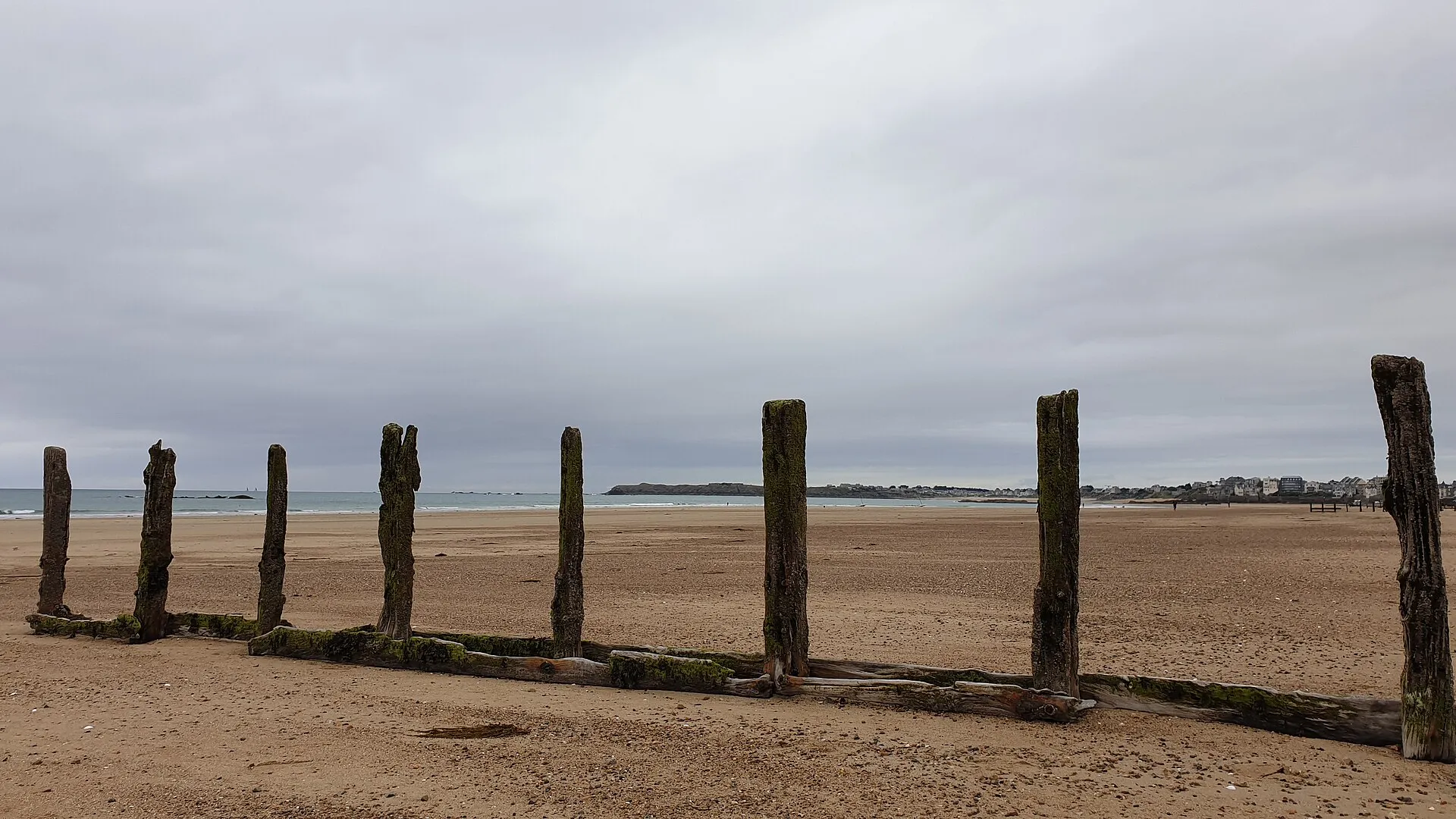
When the sea pulls out, Saint-Malo hands children square kilometres of sand. Castles are built to the scale of the tidal range: there is time to raise proper ones, moats included, before the flood arrives to test them. The warm pools trapped between the Sillon’s breakwaters turn into natural paddling grounds, and the rock fields, below the ramparts and out towards Rothéneuf, hide crabs, winkles and anemones. Two habits to pass on from the very first outing: every lifted stone goes back the same way up, because it shelters years of life; and you look for where the sea is every ten minutes, because a child absorbed in a rock pool will not see it coming back behind them.
On the big coefficients, exploring can turn into shellfish foraging: raking up cockles and picking winkles off the rocks are gestures made for small hands. The rules are learned along with the gesture: minimum sizes, quantities and permitted zones are checked with the préfecture before every outing, and anything undersized goes straight back into the water, exactly where it was taken.
The Bon-Secours pool, your swimming insurance
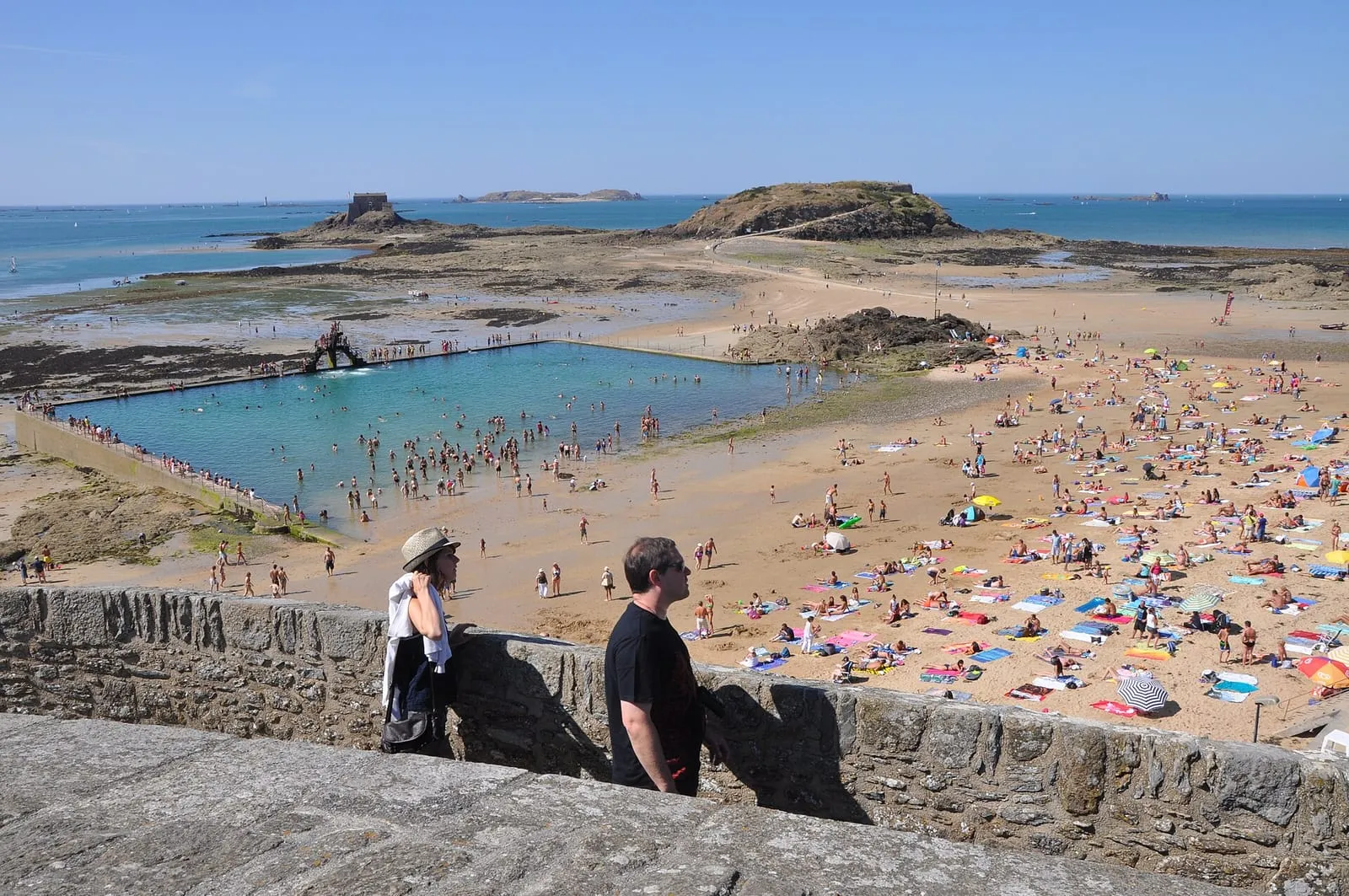
At low tide the sea can be hundreds of metres out; the Bon-Secours sea pool solves that very concrete problem. This granite basin set on the beach below the ramparts fills at every high tide and keeps its water when everything else has withdrawn: children who can swim get deep water and the three-platform diving board, the rite of passage of Malouin summers, while the little ones paddle on the beach around it. Access is free, like the beach. The pool is not permanently supervised: children swim under an adult’s constant eye, wary of the algae-slick bottom near the steps. In season, mind the flags at the beach’s first-aid post.
Which beach for which age
With a baby or a toddler, look for shelter: Bon-Secours and the Môle beach, tucked against the ramparts, are protected and a step away from the lanes of the walled town; Les Bas-Sablons, in Saint-Servan, slopes gently behind its slipway. Once past the bucket age, the Sillon becomes the great stadium: three kilometres of firm sand at low water, room enough for kites, beach rackets and castles with several building sites going at once. At Rochebonne, at the Paramé end of the Sillon, the promenade at your back simplifies the logistics: pushchair, snacks, retreat if a squall rolls in. The beaches page covers them all, and the map places each one with its access points.
The ramparts and Grand Bé: the low-tide expedition
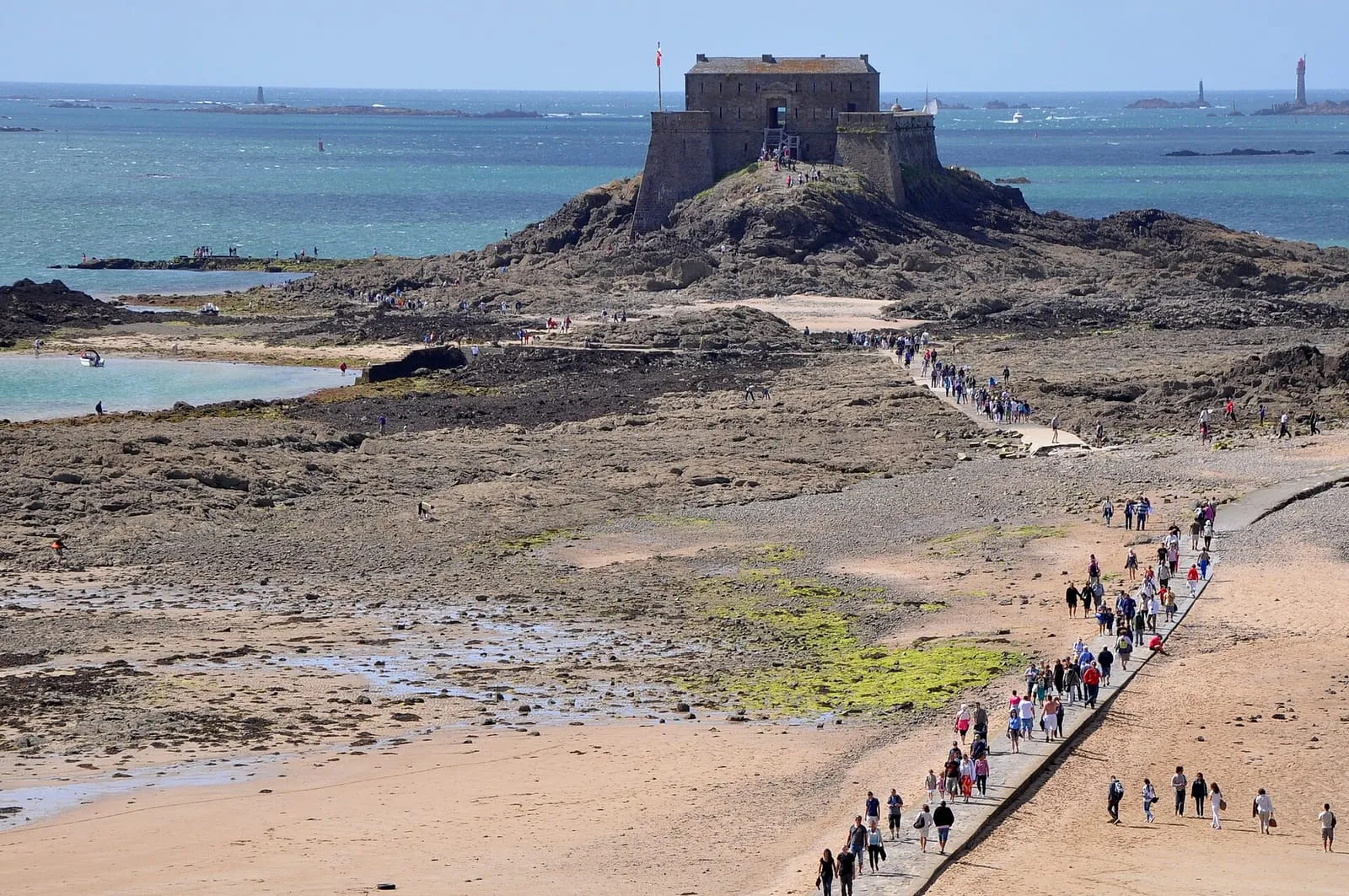
The circuit of the rampart walkway makes a good tide lesson: in one walk, children look down on the Bon-Secours pool, the islets, Fort National, and either foreshore or open sea depending on the hour. Expect stairs on the way up: a baby carrier beats a pushchair. Down below, at low tide, the uncovered causeway leads from Bon-Secours beach to Grand Bé, a few hundred metres of sand and rock to Chateaubriand’s tomb: a genuine expedition at child height, with Petit Bé and its fort in the line of sight.
This is also the moment to be serious. The rising tide cuts off Grand Bé just as it does Fort National, and walkers get trapped every year: check the official SHOM tide tables before crossing, set out while the sea is falling, and turn back the moment it touches the causeway. Never cross on a rising tide. With children, whose strides are short and detours many, allow an even wider margin than you would for yourself.
Spring tides as a family: a show watched from a distance
Days with a coefficient above 90 or 100 offer a double bill: at low water, the largest foreshore of the year; at high water, a sea that climbs until it strikes the sea walls. The show is best enjoyed from the ramparts, set back from the parapet, or from a window, never close to the waves. When the sea leaps over the Sillon’s sea wall, a breaking wave can sweep the promenade: the spectacle is to be watched from a safe distance, behind shelter, without exception, and the sea wall is no place for children on those days. Dates and coefficients are in the calendar; the times themselves are always checked with SHOM.
High tide, rainy days: plan B
At an ordinary high water the town does not shut up shop: a swim on the rising tide is often the day’s best, within the supervised areas in season, and the ramparts show their other face, with the sea at the foot of the granite. When the rain settles in, the walled town is explored porch to porch, the town’s museums take over, and the big aquarium easily fills half a day. This guide publishes neither opening hours nor prices for attractions: check on site or with the tourist office. A Breton shower rarely lasts; by the next low water, the foreshore will be back, freshly rinsed.
Written and kept up to date by a Saint-Malo local in love with this coast. The story behind this guide

_%C3%A0_mar%C3%A9e_basse.jpg)
Check the official tide times on maree.shom.fr ↗
Which Saint-Malo beach is best with young children?
The most sheltered are Bon-Secours and the Môle, tucked against the ramparts, and Les Bas-Sablons in Saint-Servan, sloping gently behind its slipway. At low tide, the warm pools trapped between the Sillon's breakwaters make a natural paddling ground. Keep an eye on the turn of the tide, because the sea comes back at walking pace.
Is the Bon-Secours sea pool supervised?
Not permanently: the pool is freely accessible and you swim at your own responsibility, with a constant eye on children. In season the beach has a first-aid post; supervision days and hours are posted there and published by the town hall. Check on the spot before relying on it.
Can you walk to Grand Bé with children?
Yes, at low tide: the uncovered causeway starts from Bon-Secours beach, a few hundred metres of sand and rock. The rising tide cuts the islet off, and the sea comes back fast: check the official SHOM tide tables before crossing, set out on the ebb, and turn back the moment the water touches the causeway. With children, allow an even wider margin.
What can you do at high tide with children?
Walk the ramparts, first of all: the sea at the foot of the granite transforms the scenery, and you can watch the Bon-Secours pool vanish under the flood. A swim on the rising tide is often the best of the day (the water returns over sun-warmed sand), within the supervised areas in season. High water is also the right slot for museums or the aquarium.
Are the spring tides a good time to visit as a family?
Yes, provided you pick your spot: the foreshore is at its largest at low water, and at high water the wave show is watched from a distance and behind shelter, from the ramparts set back from the parapet, never on the sea wall or close to the waves. Dates and coefficients are in our calendar; times are always checked with SHOM.
Is Saint-Malo manageable with a pushchair?
Partly: the Sillon's promenade runs flat and smooth, as do the streets of the walled town. The rampart walkway, though, is reached by stairs (bring a baby carrier), and sand and foreshore are easier with a child in your arms than on wheels.