Saint-Malo at the rhythm of the spring tides
Updated on 23 October 2026
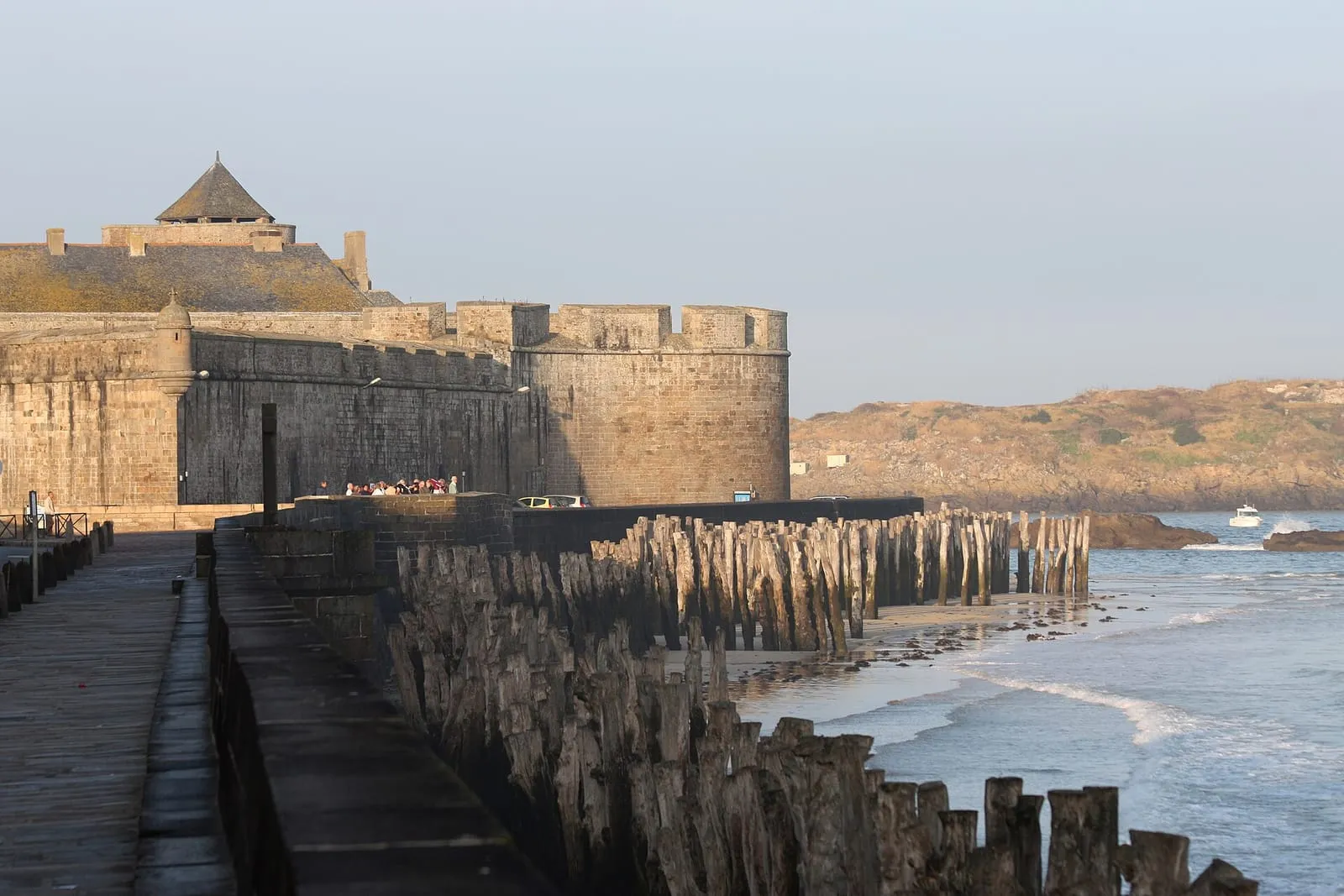

Will the sea leap the wall?
Waves over the Sillon sea wall: our index for 27–29 October 2026
Show unlikely
The sea will most likely stay calm along the wall on this date. The spring tide is still a great sight at low tide.
What drives this index
- Tide coefficient100
- Swell (significant height)1.2 m (W)
- Swell period14 s
- Wind48 km/h (SW)
Best window of the episode: 27 October 2026. Index computed on 23 October 2026.
A qualitative, heuristic estimate, not a guarantee: nature does what it wants. Swell and wind forecasts: Météo-France (Licence Ouverte).
The next spring tides
- 27–29 October 2026100autumn
- 25–27 November 202697autumn
- 25–27 December 202699winter
See the full spring tide calendarAdd these dates to my calendar (.ics)
Dates and coefficients are indicative. Always check the official SHOM tide times before heading onto the foreshore. Official tide times (SHOM) ↗
The map of the spring tides and the bay
Viewpoints, places reachable at low tide, beaches, heritage, day trips: everything is pinned on the interactive map.
- Spring-tide viewpoints
- At low tide
- Beaches
- Heritage & views
- Malouinières & manors
- Places to stay
- Safety & caution
- Practical & transport
- Day trips nearby
Open the interactive map114 places on the map
In Saint-Malo the sea level swings by more than twelve metres on big-coefficient days, one of the largest tidal ranges in Europe. Within a few hours, the same bay goes from waves hammering the Sillon sea wall to an uncovered foreshore where people walk out to the islands.
The dates are known years ahead. This guide gathers what people come looking for: the next spring tides and their coefficients, the “leaping sea” index, the year’s episodes season by season, the bay’s events, the map of the places to see and, last of all, where to stay if you are coming for the show.
Coefficients and spring tides, briefly
The tide rises and falls twice a day. Its size is measured by the coefficient, a French scale running from 20 to 120. Below 70, nothing much happens. From 90 upwards it counts as a spring tide. Above 100, Saint-Malo is transformed: high water licks the top of the sea wall, low water uncovers hundreds of metres of foreshore, and you can walk to Grand Bé without wetting your feet.
Twelve metres of tidal range is the height of a four-storey building between high and low water. The rhythm itself never changes: roughly six hours rising, six hours falling, with the whole cycle sliding about fifty minutes later each day, which is why the times need checking daily.
The strongest coefficients cluster around the spring and autumn equinoxes. In 2026, the peaks of the year: 20–22 March (coefficient 104), 17–19 April (105, the maximum), then 13–15 August and 11–13 September (both 102). Every date is listed on the spring tide calendar.
The leaping sea: where and when to watch
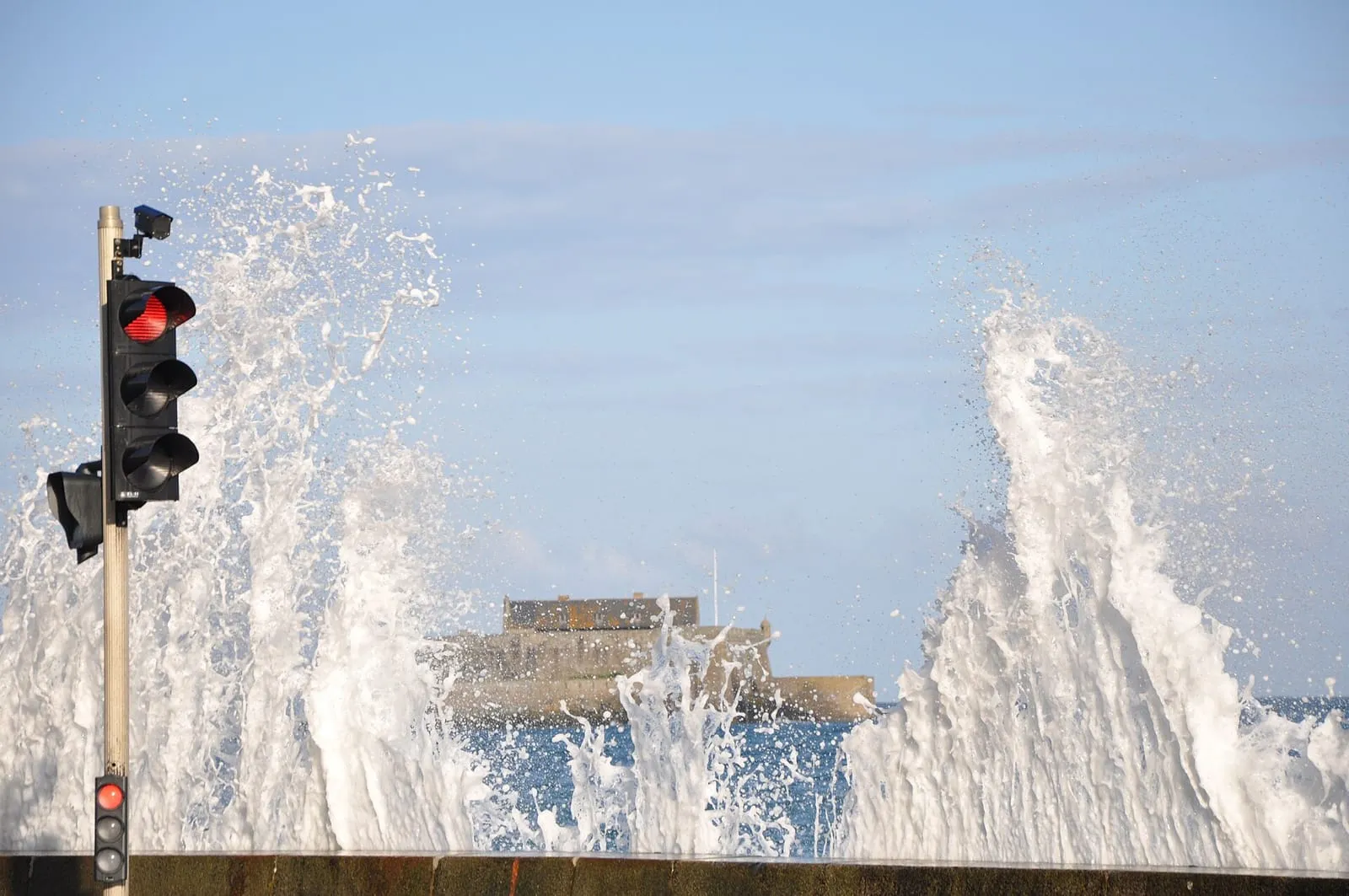
The “leaping sea” is the waves breaking over the Sillon sea wall around high water. A big coefficient is not enough on its own: it takes a well-formed swell and an onshore wind too. That combination is what the index at the top of this page sums up, computed as each episode approaches, and what the Sillon webcam further down shows live. The three ingredients of the phenomenon, and how to watch for the right slot, are covered in depth on the leaping-sea page.
The best vantage points: the promenade set back from the Sillon sea wall, the Intra-Muros ramparts and the castle esplanade. Every viewpoint has its own entry. The show is one to watch from a safe distance, behind shelter, never from the sea wall or the pier: breaking waves can sweep a person away. And before any outing, check the official SHOM tide times: the sea comes back in fast across this bay.
A year of spring tides: the dates that structure it
Each season has its own character. The spring equinox brings the year’s biggest coefficients in lengthening light; the autumn equinox replays them in September, once the town has quietened down and the first depressions start sending swell. The winter spring tides belong to the wave-watchers: more modest coefficients, but frequent storms, and that is often when the sea leaps best. The summer episodes, finally, are the most family-friendly: the foreshore uncovers in mild weather and shore foraging is in full swing. In 2026 the August episode is every bit as strong as September’s.
In all, 2026 counts sixteen episodes at coefficient 95 or more, roughly one a fortnight, pegged to the full and new moons. In other words: whenever you come, a spring tide is rarely more than a fortnight away. The calendar will tell you whether one falls during your stay.
Visiting to the rhythm of the tide
At low tide the bay becomes a walking ground: the crossing to Grand Bé, beaches suddenly twice as wide, shore foraging on the foreshore. Everything low water opens up is gathered on the low tide page. At high tide, climb the ramparts to take the measure of the Channel, swim at high water, or head out to the surroundings: Dinard, Cancale, Cap Fréhel. All of these places are gathered on the interactive map, along with the spring-tide viewpoints and the low-tide crossings.
That is what makes Saint-Malo singular: you don’t work through a list of sights here, you follow a clock. The same day holds two towns, the high-water one and the low-water one, and the day is planned around the turn of the tide rather than around opening hours.
Planning your visit
Three habits are all it takes. Pick your dates in the calendar: an episode at coefficient 95 or more if the tide is the point of the trip, and ideally a full weekend. Forty-eight hours on site gives you four tides. Check the official SHOM tide times as the trip approaches: high and low water shift every day, and the whole day is built around them. Book early, finally: the spring tide dates are public, and the front-row places to stay go months ahead.
Once here, the whole seafront is walkable (the TGV station is about twenty minutes on foot from the walled city) and a windproof jacket makes high water comfortable in any season, spray included.
Where to stay for the spring tides?
If the tide is why you are coming, the neighbourhood matters more than the star rating: the Sillon to sleep facing the waves, Intra-Muros for the ramparts and the lanes, Saint-Servan for gentler prices around the Solidor tower, Paramé for the seafront’s eastern reach, Dinard for Saint-Malo’s skyline in your window. For the equinox episodes, book several months ahead: the dates are public, and demand follows.
The Sillon sea wall, live
The Thermes Marins webcam on the seafront shows the actual state of the sea on the wall. It completes the tide calendar and the index above.
Official stream: Thermes Marins de Saint-Malo · Vision-Environnement.Watch on YouTube ↗·Thermes Marins webcam page ↗·Other webcams around the bay ↗


.jpg)
Frequently asked questions
What is a “spring tide” and a tide coefficient?
The coefficient (20 to 120) measures the tide's amplitude. From 90 upwards it is a spring tide: the sea rises higher, falls lower, and uncovers miles of foreshore. In Saint-Malo, home to one of Europe's largest tidal ranges, a coefficient above 100 reshapes the landscape twice a day.
When are the spring tides in Saint-Malo in 2026?
The strongest episodes of 2026: 20–22 March (coefficient 104), 17–19 April (105, the year's maximum), 13–15 August and 11–13 September (both 102). The year holds sixteen episodes at coefficient 95 or more in all. The next dates are on this page and the full calendar on its dedicated page; always check the official SHOM tide times before any outing.
What are the “leaping sea” waves?
They are the waves that break over the Sillon sea wall around high water, when a big coefficient meets a well-formed swell and an onshore wind. The show is spectacular and dangerous: watch from a safe distance, behind shelter, never from the sea wall or the pier. The index at the top of this page estimates the odds for each episode.
Are the spring tides dangerous?
They can be, when underestimated: the rising tide rings the sandbanks and closes the causeways to the islets, and in heavy weather waves sweep the sea wall and the pier. Two rules remove most of the risk: check the official SHOM tide times before any outing on the foreshore, and watch the waves from a safe distance, behind shelter, never from the sea wall.
Which area should I pick to watch the tide rise from my room?
The Sillon seafront is unbeatable: the sea wall faces the open sea and its hotels look straight onto the waves. Intra-Muros offers the walled-city atmosphere but few rooms with a clear sea view; Saint-Servan and Paramé are quieter and more affordable, minutes from the show.