Understanding the tides: why Saint-Malo has Europe's biggest
Updated on 31 July 2026
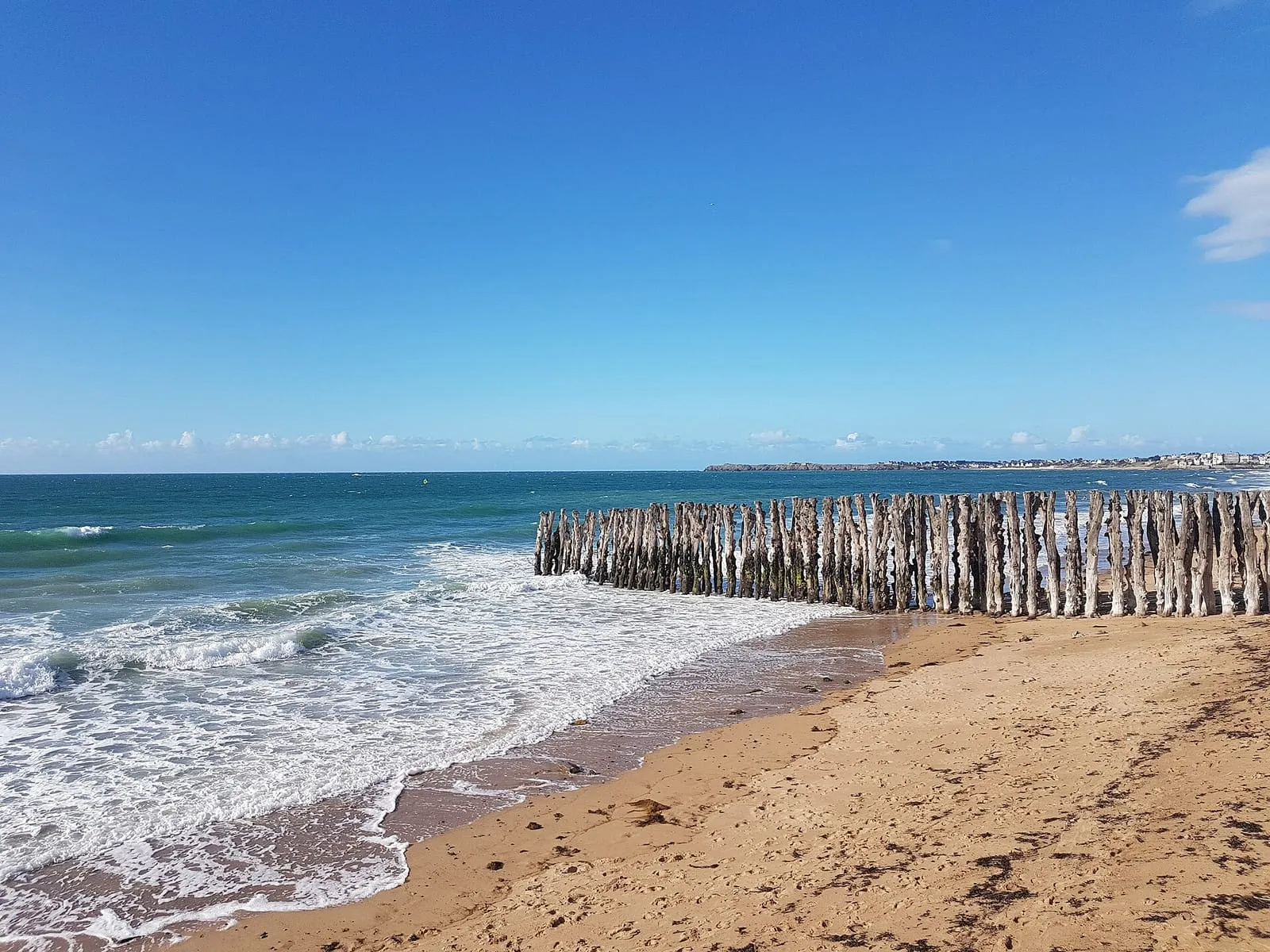

Twice a day, the sea at Saint-Malo rises and falls by the height of a four-storey building. The phenomenon can be watched from the ramparts and walked on the foreshore. It can be understood in a few minutes. This page explains the whole machinery: what the Moon and the Sun actually do, why the rendezvous returns every fortnight, and why it is precisely here, between Brittany and the Cotentin, that Europe gets its biggest tides.
The machine: the Moon, the Sun and an ocean that deforms
It all starts with a pull. The Moon draws the ocean towards it and raises a bulge of water on the side of the Earth that faces it. Less intuitive: a second bulge forms on the opposite side, because the Earth and the Moon revolve around a common centre of gravity and the water on the far side, pulled less, is “left behind”. The ocean thus takes a slightly oval shape, with two swellings diametrically opposed.
The Earth, meanwhile, spins on itself in twenty-four hours. Each coast passes under both bulges in turn: two high waters and two low waters a day. And since the Moon moves along its orbit in the meantime, it takes about 24 h 50 min to find it in the same place again: the tide slides about fifty minutes later each day. That is the whole explanation for the Saint-Malo ritual of checking the day’s times (against the official SHOM tables) before making any plan.
The Sun plays the same score, with roughly half the Moon’s effect (far more massive, but far further away). It is its alliance or opposition with the Moon that writes the entire calendar.
Springs and neaps: the fortnightly metronome
When the Moon and the Sun line up with the Earth, at every new moon (all three on the same axis) as at every full moon (the Earth between the two), their effects add up: these are the spring tides. When they pull at right angles, at the Moon’s quarters, their effects work against each other: these are the neap tides, when the sea barely seems to move.
The alternation follows the lunar cycle: a spring tide roughly every fourteen days, arriving a day or two after full or new moon. Twice a year, around the equinoxes of March and September, the Sun crosses over the equator and the geometry becomes optimal. The spring tides peak: that is the great equinox rendezvous, the one that fills the Sillon hotels.
This astronomical metronome has one precious consequence: the tide can be computed years in advance. The dates in our spring tide calendar are not weather forecasts but applied astronomy: only the swell and wind, which decide the wave show, stay unpredictable beyond a few days.
The coefficient: France’s tide scale
France measures the size of the tide with a tool the world envies: the coefficient, a unitless number from 20 to 120 published by SHOM. The anchors to know: 45 is an average neap, 95 an average spring tide, 100 an average equinox spring, 120 the theoretical maximum. From 90 upwards, usage speaks of a grande marée (a big spring tide).
One useful subtlety: the coefficient is national. The same day carries the same coefficient from Dunkirk to Hendaye. What changes from port to port is its translation into metres. A coefficient of 100 lifts the water by about a metre in Marseille… and by more than twelve metres in Saint-Malo. Hence the next question.
Why Saint-Malo, precisely
The tidal wave is born in the Atlantic, where it stays modest. Heading up towards the Channel, it meets a three-part trap:
The funnel first. The Norman-Breton gulf (that great rectangle of sea between the Breton headlands, Jersey, Guernsey and the Cotentin) closes like a dead end. The wave’s energy, squeezed into a shrinking space, has nowhere to go but up.
The seabed next. The Channel is a shallow sea: the tidal wave slows and rears up in it, like a wave touching the beach. The more the bottom rises, the more the water piles up.
Resonance last. The basin’s dimensions make the wave reflect back and forth at a rhythm close to the tide’s own: the oscillation feeds itself, like bathwater pushed at just the right cadence.
The result: a tidal range of 12 to 13 metres on the biggest coefficients at the foot of the ramparts, the largest tides in Europe, among the strongest in the world behind Canada’s Bay of Fundy. And at the bottom of the same funnel, the bay of Mont-Saint-Michel pushes the logic to the extreme: the sea withdraws more than ten kilometres, returns “at the speed of a galloping horse” according to legend (of a brisk walker in reality, which is quite enough to trap people) and even runs back up the rivers in a single wave, the tidal bore.
Flood, ebb, slack, turn: speaking tide
Four words are enough to follow a conversation on a Saint-Malo slipway. The flood is the rising tide; the ebb, the falling one; slack water, the short hour when the level stops moving, at high and low water alike; the turn, the instant the current reverses. One detail changes everything in the field: the tide does not advance at a constant speed. Slow at first, it runs fastest at mid-tide (through the middle “twelfths” of the rise), then eases towards slack. It is at mid-flood that the water gains dozens of metres in minutes across the flat foreshore, and that is exactly why the local rule says head back at the turn, not when the water reaches you.
From theory to spectacle
The rest of this site puts that machinery to work: the calendar to pick your spring tide dates, the leaping sea to understand what weather adds to astronomy, low tide and high tide to plan your days, and the Rance tidal power station to see what engineering made of all that energy. One last reminder, always the same: theory exempts you from nothing. Before any outing on the foreshore, check the day’s official SHOM tide times.
Written and kept up to date by a Saint-Malo local in love with this coast. The story behind this guide


The next spring tides
- 11–13 September 2026102autumn equinoxequinox
- 27–29 September 202699autumn equinoxequinox
- 10–12 October 202695autumn
Why are there two tides a day?
Because the ocean deforms on both sides of the Earth at once: one bulge of water facing the Moon, pulled towards it, and a second on the opposite side, due to the rotation of the Earth-Moon pair. As the Earth spins, each coast passes under both bulges, hence two high waters and two low waters per lunar day, about 24 h 50 min.
Why does the tide time shift every day?
Because the Moon moves along its orbit while the Earth spins: it takes about 24 h 50 min (not 24 h) for a point on the coast to face the Moon again. The tide therefore slides about fifty minutes later each day, which is why you check the official SHOM times daily rather than once and for all.
What exactly does the tidal coefficient measure?
The amplitude of the water's movement, on a 20-to-120 scale published by SHOM, the French hydrographic office: 45 is an average neap tide, 95 an average spring tide, 120 the theoretical maximum. It is a national indicator (the same day carries the same coefficient in Saint-Malo and Biarritz), but its effect in metres depends on the place: here, it is magnified.
How high does the sea rise in Saint-Malo?
The tidal range (the gap between low and high water) reaches 12 to 13 metres on the biggest coefficients, the height of a four-storey building, among the strongest in the world. The funnel effect of the Norman-Breton gulf amplifies here a tidal wave that is already powerful in the Atlantic.
Can tides be predicted long in advance?
Yes: the tide is an astronomical phenomenon, computable years, even decades, ahead. That is why our spring tide calendar can show reliable dates so early. What cannot be predicted far ahead is the weather on top: swell, wind and surge only firm up a few days out.